 Ever since 2004, when I'd first considered travelling to Mexico, I'd always planned to make a trip to PdC, lured by its crystal blue waters, pristine beaches and the promise that it isn't yet overdeveloped like Cancun. Hurricane Wilma rearranged the trip, which in retrospect was fortunate (for me) as it meant I went west from San Cristobal rather than spending over a fortnight in the Yucatan and another week in Spanish school.
 But internet message board postings suggested that by this point PdC and other parts of the Yucatan had been patched up so here I was on my way. But the same time I was increasingly aware that the end was not far off. I planned to spend several days chilling out and not doing very much so the time would probably speed by. I didn't realise that these last five days were destined to be some of the busiest and most fulfilling yet.
But first I had to get to the Yucatan peninsular, and that meant a flight from Leon airport (45mins from Guanajuato city centre by taxi) to Mexico DF and then a connecting flight to Cancun airport. I got stung for overweight bags at Leon - when I said I would repack the case and stick more heavier objects in my hand luggage the guy behind the desk saved me the trouble by striking several kilos off the total. Still the excess charge still came to nearly half the original ticket price.
Then on the second leg of the flight I got placed behind three Mexicans who had obviously never flown before. The guy in front of me seemed convinced the plane's seats should fully lie back like they do on buses and spent the whole flight retracting and reclining his chair in a bid to make it get back further.
At the airport I got a scare when every bag came off the conveyor before mine. By this point my case was smashed up, unstitching and generally in a bad way so I wasn't sure it would survive the trip. It did but arrived burst open with several of my possessions piled on top - luckily nothing was missing. The honeymooning couple standing next to me laughed when it appeared, but lost their smiles when they realised their bags had never made their connecting flight. A very charming luggage guard led them away, but I'm sure it wasn't the start they had wanted.
So by this point I was slightly frazzled. The first sign that things were about to drastically improve was the discovery that there was a frequent cheap bus service from the airport to Playa. The second was meeting a very cool local whilst waiting for the to board. He was just returning after a month away and was about to see the damage done to his home. He'd already been told that his appartment had been looted and his computer and scuba diving equipment were missing. Neverthless he was in a good mood and the hour long ride shot by as he described in Spanish all there was to do in town.
By the time we drew into Playa it was around 10 o'clock so it was hard to see what damage the hurricane had done, although my new friend noted there were far fewer palm trees on the approach road. As we got off the bus he pointed me in the direction of my hostal which was about a 20sec walk from the station, right on 5th avenue - the main strip. I had a quick shower, changed and went out to explore.
 It was obvious from the start that Playa del Carmen's party spirit had survived Wilma. Trendy bars and restaurants lining the avenue were all pumping out cool latin tunes. The resort wasn't packed, but there were quite a few others hanging out and soaking up the carribean vibe. As I later found out lots of the nearby hotel complexes have converted to all-inclusive resorts so many tourists don't go out until late. The other other noticeable change was the humidity. It was hot and sweaty - so much so that after a 20min wander I had to go back to my room and change my t-shirt!
Slightly refreshed I headed back down 5th Avenue until where it intersects with Calle 12 where one of the locals insisted he give me a guided tour to the best bars in town. Sensing a scam I tried to say no, but he was persistant and so long as I stayed to the main streets I couldn't see the harm. He tried to use me as a means of getting into one of the resort's most popular beach bar/discos -The Blue Parrot Inn - but was still turned away at the door. After about 15mins I had a better idea of what was where and managed to convince him I'd seen enough. Sure enough he demanded a tip, but seemed surprised when I gave him more than he asked since the info he'd given me was genuinely useful.
Once he'd disappeared to prey on some other tourist I headed back to The Blue Parrot. Despite its dodgy name it's genuinely one of the most popular bars in town. Owned by the nearby hotel, of the same name, it's a stylish palapa beach club. The bar us surrounded by swings so you scan rock back and forth as you sip a cocktail, or relax on one of the nearby big chairs grounded in the sand. Near midnight a group of fire dancers took over the dance floor and put on an impressive display, spinning their torches feet in front of the applauding crowd and creating paths of fire on the floor which they then walked through, all to the sound of their own drums. With light from the nearby lighthouse projecting onto the sea behind them it was a great introduction to the Yucatan.
 Daylight gave me a chance to appreciate just how quickly Playa had fixed itself up after the storms. Most of the 5th Avenue buildings seemed in perfect order, although builders were still re-weaving several of the rooves. Slightly further down closer to the beach a few other properties had obviously taken the brunt of the winds and would need more work, including Playa's Señor Frogs nightclub which had been shut up for major renovations.
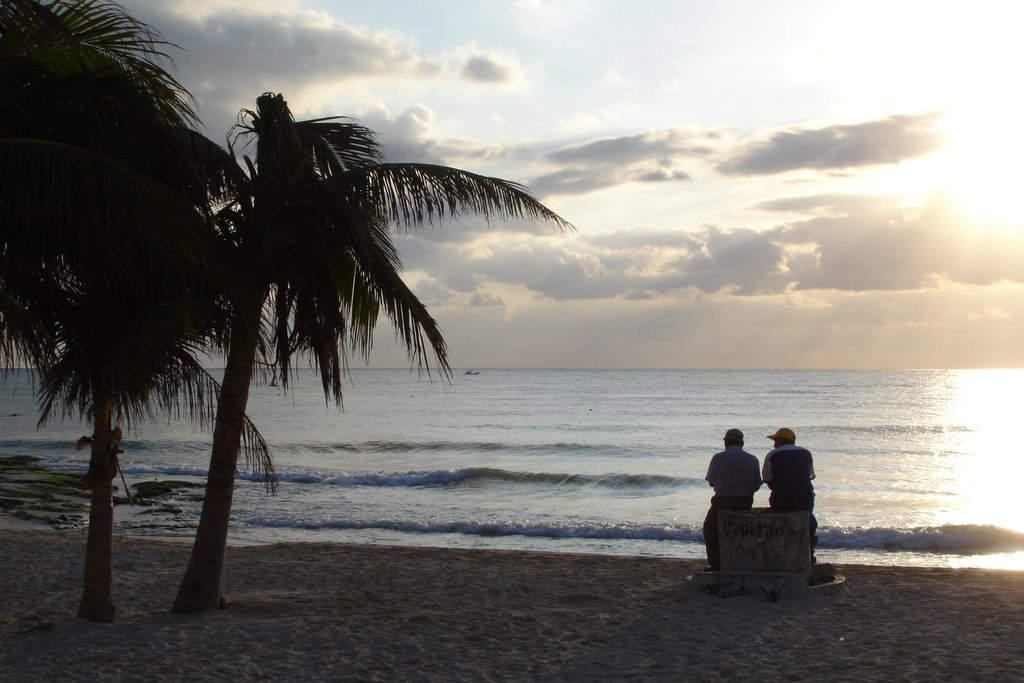
 Along the beach itself the most noticeable thing was a wall of sand coming up to my waist at the point where the water reached its furthest at high tide (you can get an idea by enlarging the photo on the left). The hurricane had denuded Cancun's beaches, leaving miles of uncovered rocks pictured in the newspaper alongside huge estimates of how much it would cost to recover them. Playa del Carmen was the beneficiary - and as if to offer further proof it a few jcbs were out flattening the sand back down in a few roped off areas.
 After a yummy breakfast at The Coffee Press (Calle 2/Avenida 5 - another great LP reccommendation) I headed off on another of my mammoth walks northwards along Playa's beaches. The sea looked like someone had managed to photoshop reality - shades of aquamarine glinting under the sun - and walking barefoot through it was like dipping my feet into a warm bath - bliss! About 45mins out, on the edge of the main developed area the hurricane's damage was more obvious. Here where the work crews were still to start repairs palm trees lay crashed against the sand, beach huts lay exposed roofless and the odd coconut laid half buried in the sand. But at the speed everyone seemed to be working I'm guessing that over the past few weeks since I've been back even these parts will be patched up and probably looking better than they were before.
Most of the rest of the day was spent relaxing under the sun, checking out the excellent local shops, sipping beers at one of the bars whist reading Gabriel Garcia Marquez's biography and generally chilling out.
I'd met a Scotsman at the hostel in the afternoon and we went out for a few drinks in the evening. He was flying off to Cuba the next day and I was booked onto a morning tour, so it wasn't a wild night - but it was good to be chatting away to a fellow traveller again - the first proper English conversation that lasted longer than 15mins since Zacatecas.
 Maybe I'd been spoilt by this point but I wasn't blown away by Chichen Itza. Don't get me wrong - the ruins themselves are incredible, impressive, inspirational and other words that don't have to begin with 'i' - but the whole site has been over touristified.
 The tour had set off fairly early in the morning. For the first, and only time, this trip I was sharing the van with a group of people I had absolutely nothing in common with - a group of Americans enjoying their recent retirement who were experts in motorway maintenance and a group of French who seemed to have picked up the English habit that if they repeated a phrase enough times at the rest of us we'd understand what they were going on about. I sat up front next to the bemused Mexican driver who had a fixed grin on his face and probably just wanted to get through the day as fast as possible.
I'd booked after carefully selecting what seemed the best tour cabin on 5th Avenue - but the driver explained to me that they all subcontracted their bookings to the same company anyway. They all charge the same price in dollars but confusingly convert it into different peso prices - so if you're looking to book you may as well go with the cheapest.
First stop was a weaving/artisan station showing how certain cactus plants can be turned into thread, paper and needle and thread - similar to the one on the Mexico City tour. This time though the rest of the group seemed more interested in taking a cigarette/beer break than listening to what was going on.
Then we arrived at Chichen Itza. The first inkling that things were going to be a bit different to previous ruins visits were the neon pink armbands we were given. Then entering through a huge stone entranceway and turnstiles we joined the throngs of other tourists who, despite their huge numbers, seemed to be matched by the numbers of Mexicans selling identical art, sculptures and other tat at what was admittedly very reasonable prices.
Let's face it - this is the most popular Mayan site in Mexico's most popular tourist destination, so I shouldn't have been surprised. And once I accepted this wasn't going to be the mystical experience of Palenque or even the sheer wow factor of Teothicuan there was lots to enjoy.

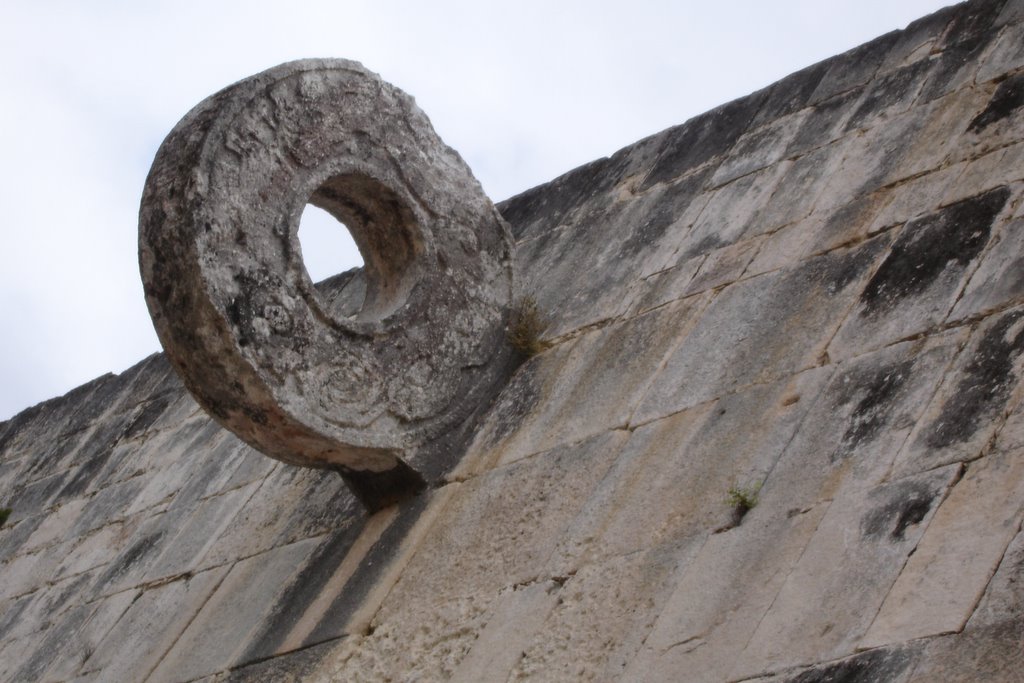
One highlight is the ancient city's pelota court. Archaelohists believe the Toltecs would kick and whack a heavy hard rubber ball along the 135 metre court trying to aim it through one of the hoops fixed high above their heads. The players were forbidden to use their hands so even with padding I'm guessing they'd expect to get serious bruising before scoring the 10th century version of a basket and bringing an end to the game. Worn carvings along the side depict what's thought to have happened next. The top player, and possibly his team mates, would then present themselves to the priest who rewarded their victory by chopping off their heads. Yes, you read that right score a hoop and you got to paint the ground with your lifeblood. Hardly the greatest incentive. Supposedly this was a great honour as you got to head up to their version of heaven and meet the gods - but I'm betting some of the games would have gone on for a very l-o-n-g time with many a player's aim suddenly found to be wanting.
To be honest I'm not totally convinced by the archaelogists' explanation - reports from the time of Cortes described unwilling victims being caged ahead of their sacrifice to the gods. But I guess there are plenty of kamikazes throughout history willing to give up this life for glory in the next one. All the same don't be shocked if in a few years a startling new discovery suggests it was the losers who got turned into neck fountains.
Another thing to check out before looking at the rest of the site is the acoustics. Clapping your hands produces echoes along the length of the walls - the sound produced when the games were underway must have been deafening. But what's amazing is the stands at either end. A person speaking at normal level at one end can be heard perfectly clearly at the other. Useful for a pre walkie talkie age and I guess no-one had to miss out on the death garggles of the victors offering future generations their own personal disproof of Darwin's of survival of the fittest theory.
 Our guide then took us on a tour of the rest of the site, swapping between French, Spanish and English. Huge carved serpent heads, in honour of Kukulkan, the feathered serpent god, still jut out of the Temple of Venus, while nearby the platform of eagles and jaguars gets its name from the animals shown holding up human hearts ripped out of their owners' chests to keep the gods happy in between pelota matches.
 Next door the Platform of Skulls holds endless carvings of the heads of sacrificed prisoners and other victims, possibly as a warning to potential invaders that the city's inhabitants were fierce, clearly psychotic, and not to be messed with.
Cheery place.
No visit would be complete without scaling Kukulkan's pyramid. The structure covers previous smaller pyramids which were built on at the end of a cycle of years to represent renewal.
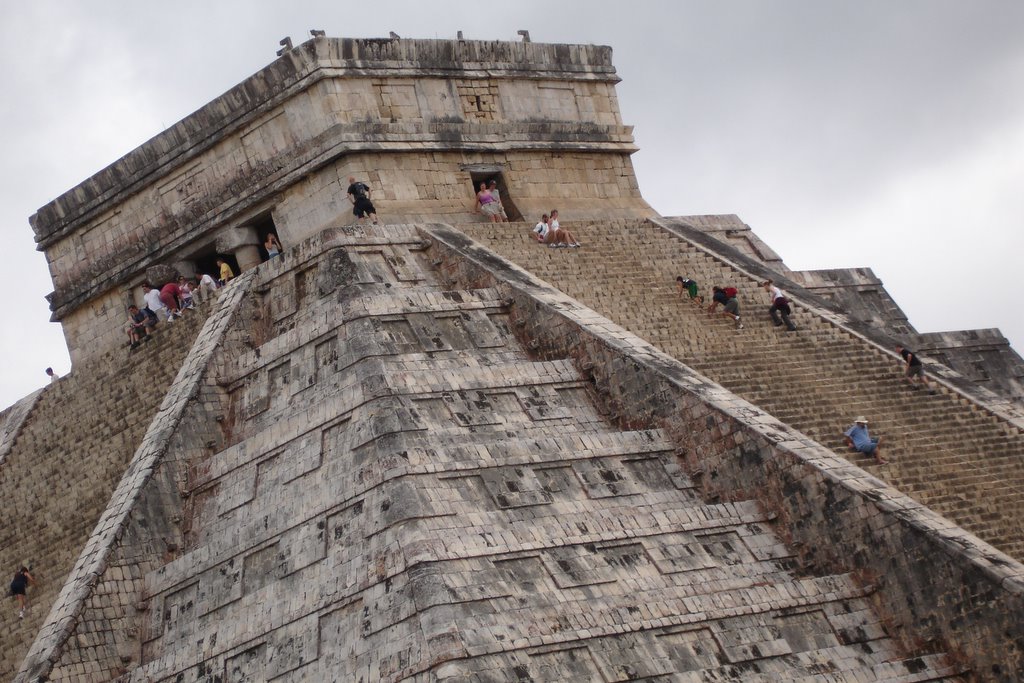 In fact the whole building is an elaborate calendar - each of the four sides originally had 91 steps. Add the platform at the top and you have a step for every day of the year. Every Spring and Autumn Equinox (March 20/21 & Sept 21/22) a shadow cast by the sun creates the illusion of a snake slowly winding its way down the pyramid as if about to head off along the path in the direction of the nearby sacred cenote. A warning if you plan to visit the site on these dates - it's supposed to be absolutely mobbed. A nightly son & lumiere show recreates the spectacle and probably offers a better view for those staying at a nearby hotel.
Again the architects proved themselves masters of acoustics - stand at the bottom and you can hear someone at the top speaking at normal level, and if you shout from the bottom your voice comes back as a piercing shriek.
 The view from the top gives great views to the Plaza of A Thousand Columns and the Temple of the Warriors (seen on the left of the picture). The other side is probably the perfect place to grab a front row seat on December 22nd 2012 when Kukulkan is predicted tol rise from beneath the pelota court and destroy the world.
But for those of you who manage to visit between now and then a warning - the climb up is a hell of a lot easier than the one back down. The Toltecs and Maya had little feet and obviously great powers of balance. Sliding down with your bottom pressed against the stone may not have been my most 'manly' display this trip- but it was a significantly less attention grabbing than descending towards the ground head first.
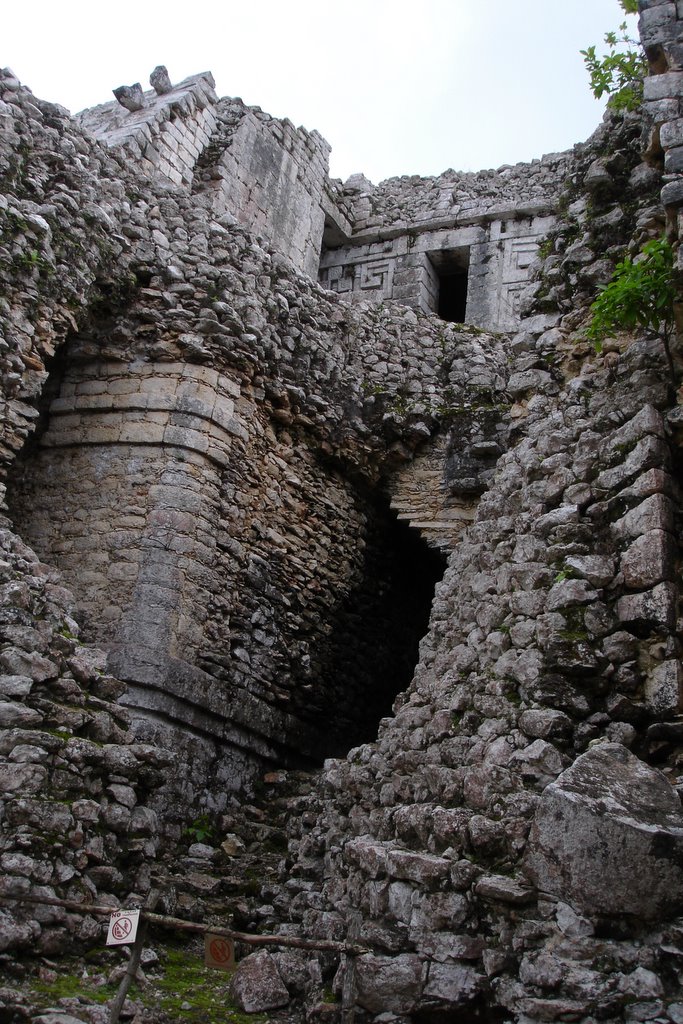 There's plenty more to see including an ancient observatory, a second ruined pyramid and lots of other half collapsed buildings and temples. Ignore the hawkers trying to convince you a fiercely ugly wooden Mayan god's face is just what you need above the mantlepiece and it's impossible not to be in awe of the number of buildings, especially when you consider several piles of stones half covered with vegetation used could be added to the total in ancient times. After the end of the tour I wandered slightly off the main route where I spotted an army of workers reconstructing a huge building away from the eyes of most visitors. While their efforts were clearly bringing this ruin back to life I had the nagging worry that too much reworking could ultimately leave this place with a theme park feel.
I guess for the best experience of Chichen Itza you should pay attention to the guide books, stay close and visit either early in the morning or late in the afternoon. But if you've got the chance to travel around lots of Mexico and see other sites I'm not sure I'd use up one of my nights this way - better to get a small taste of the place, not have too high expectations and spend more time at other less 'popular' places.
For more info on the ruins check out:
After a basic and bizarre buffet lunch - how often do you get to watch young kids doing a traditional dance balancing filled beer bottles on their heads? - we headed onto what was for me a highlight of the day and one of the most memorable hours of the entire five and a bit weeks: My first chance to swim in an underground cenote.


Many of the group were put off by the steep slippery climb into ground at Cenote Samula's entrance. They missed out. Deep underground those of us who dared to strip off to our swimming costumes had the chance to swim in the huge natural underground pool.
Cenotes were formed when a meteorite smashed into the Yucatan Peninsular around 65 million years ago causing cracks to slowly form in the area's limestone rock. These fissures filled with water which eroded and created huge caverns which are all interconnected by a huge system of underground rivers. Samula's claim to fame is the huge poplar tree roots which squeeze through a hole in the ceiling to stretch down and sip at the water below. The temperature is warmer than you'd think - possibly in part due to the sheer exhilaration of enjoying such an extraordinary experience.
Time on site went all to quickly. A quick visit to the nearby town centre of Valladolid rounded the day off. There's a big church in the centre and some small shops to wander around and for most of the others on the tour it was probably their only chance to see the 'real' Mexico - though they seemed more interested in the bar which we'd parked by. I was more interested in a huge Aids (SIDA) rally which marched into the main square handing out condom awareness leaflets along the way. On arrival several speeches were made about the need for protected sex before the crowds dispersed - I guess quite a controversial decision in a such a Catholic country.
The Vatican's ban on birth control is seen as one of the main reasons the population swelled from 22 million in 1944 to nearly 100 million at the end of the 20th century. State sponsored family planning clinics have since been set up and the aim is to balance the number of births and deaths. But overpopulation and I guess sexual diseases remain a key issues if Mexico's hopes to raise many of its citizens' standard of living.
Just before we set off to return to playa the zocalo filled with birds flying from every direction to perch on the square's trees and sing their lungs out as dusk fell. Branches sagged under their weight and the air was heavy with their songs.
On the way back we dropped off most of the other guests at various all inclusive megabucks resots in PlayaCar - the exculsive condo/super-hotel part of town. Hotel lobby entrances revealed what looked like kilometres of marble, ornate christmas trees and huge urns of flowers. A festival of spending, a spectacle of wealth. 'Es otro mundo' I said to the driver who smiled an nodded. Another world. The attraction is obvious, and if I ever dare to total up my travels I know the final sum won't be cheap, but at that moment I had a strong sense I'll long be more relaxed in a budget setting using money to travel and tour rather than staying in one place however luxurious.
 Thursday was to prove just how great high adrenaline and a lot of mud can be. I'd eyed up the ATV explorer tour on playa.info's website weeks ago and had emailed them the day before to reserve a place. There hadn't been a reply but I was keen to make use of the 10% discount offered at the below link. The normal rate is $48.50 and would have to be paid in full if I booked through an agency.
By lunchtime there was still no reply, but I figured the 3pm tour was unlikely to be as busy as the morning ones and figured even if their computer had broken down they could still probably fit me in. So I hailed a taxi to get the 5km to the site and soon arrived... to find the office had forgotten to check for online bookings and wasn't planning an afternoon tour. Had this been the UK I'd have probably got a brief apology and been sent on my way. But since it was Mexico they shrugged their shoulders and asked if I'd mind a private tour. Cool!!!
The first inkling things might get dirty were the dirt spattered 10 drivers who returned from the previous tour. The hurricane's rains were still a long way from drying off so the paths were extremely muddy. My guide was a very friendly guy in his mid twenties from Mexico city who had been educated in the US so had perfect English. We'd been chatting for 30mins before setting off (I'd arrived early to ensure a place) and had struck up a rapport. He gave me a very basic guide on how to get the quad bike going and we were away.
As you should be able to see from the pics there is no protection. The ATV's go up to 60km per hour and since there were just the two of us we maxxed them out at least a few times. The sensation of zooming through a path that's not much wider than the bike at high speed is exhilarating - knowing one clumsy nudge of the wheel could send my head smashing into a tree trunk only added to the excitement. At first the guide kept the speed down but as it became clear I was sensible enough to deccelerate before the turns and wasn't going to shoot over the handlebars he took it up a notch. I felt more alive on that ride than I have done in certain years.
As we went deeper into the jungle the damage wreaked by Emily again became apparant - trees toppled and lying flat or against their neighbours, deep ditches of water and scattered vegitation. After a while we arrived at a huge cave illuminated for our visit by a small power generator. My guide told me that until a few weeks ago a huge colony of bats lived there, scaring many of his tours, but they'd fled during the storm and had not returned. Then onto a cenote where we both swam in the clear waters. A swimming mask was provided allowing me a glimpse into how deep the waters go. It was like looking into an abyss as the waters descended into one of the mouths of the underground river system.
The guide told me normally there would be many more stops and starts to keep the groups together and to calm overcoonfident drivers before they crashed into each other - the single customer tour might not earn him as much money but it was clearly a less stressful experience.
 Final stop was a small ruin half covered with vegitation - then he put a finger to his lips and pointed into the undergrowth. There stood a black bob tailed deer staring at us. A sacred animal worshipped by the ancient Maya. If we hadn't cut our engines minutes before to take photos the noise would have undoubtedly scared it off. Instead it stared at us for 10 seconds, no more, then turned and then shot back into the jungle. My guide said he'd known deer lived nearby but neither he nor the other guides had ever seen one.
Back at base I realised I should have booked a taxi to pick me up earlier. The guides were keen to get away and rather than delay them I said I'd walk back. Was I sure? they asked. Of course I was. Big mistake.
What had seemed like a short burst along the motorway on the way there was a hell of a long walk back. Things weren't helped by the fact I was effectively walking along the hard shoulder. Every time a car, or worse a lorry approached I jumped into the grass verge - but it was too rough to walk in and I had a sneaky suspicion snakes lurked within. So every time there was a lull in the traffic I'd run for a stretch, then jump back to make sure I wasn't hit and turned into roadkill. After 30 mins as the sky started to darken I realised I was in trouble if I didn't get back very soon.
Not long after I came to the turn off to PlayaCar and said a small prayer of thanks to God. It seems ridiculous now but I honestly think the previous half hour was the most dangerous of my life. One distracted driver, a swing of the steering wheel and I'd be a smudge on the landscape.
But the trek wasn't over yet. PlayaCar is a maze of streets - lots of million dollar properties but also tons of plots half built or still overrun by jungle. With no street lamps it was very dark in places and what was supposed to be a 40min walk, maximum, was now more than double that. Things weren't helped when a bunch of workers sent me off in the wrong direction - only for guards on one of the barriers to set me right forcing me to double back and lose 15mins. Eventually, nearly an hour and a half after I left the ATV site, I got back to 5th Avenue and what felt like a return to civilization.
A shower to get rid of the sweat and solidified mud and stop to the next door beer shop and I was ready for the evening. I headed up to the hostel lobby in the hope of finding a crowd of English speaking fellow travellers and for the first time wasn't disappointed. A bunch had moved into the hostel that day including a laid back Dutch guy, 2 cute stripper lesbians who had cashed in their savings for the trip of a lifetime together (no, really), and Erika, a laid back English girl who was completing her diving certificate before going to swim with sharks in Hawaii for the amusement of tourists who'd watch from the safety of a boat. She hadn't told her parents yet about what the job involved and was hoping to out it off as long as possible - especially since the chain mail protective gear she would have to wear might reassure the crowds but was known to be little use at repelling a determined shark's attack.
After a few drinks I excused myself as I needed to pay for next day's tour in advance but said I'd be back shortly and would join the others for dinner. If by some weird chance they're reading apologies - I never made it back.
Seconds after leaving the tour office I did a double take. The girl in the black dress who had just wooshed past me seemed very familiar. I hadn't registered her face but on some subconcious level I must have recognised her as I twisted my head to get a second glance and realised it was Anne-Lie, the girl I'd toured with in Chiapas (see the San Cristobal Chapter).
 We'd had a loose arrangement to meet in Playa if we both made it there and I'd given her my email address but hadn't heard from her so assumed she'd gone elsewhere. It turns out she'd arrived the day before and had decided to leave it to fate as to whether we'd see each other. If we did, great, if not she would leave the following morning. So by some weird coincidence we spotted each other just in time. If I'd left for the tour office ten minutes earlier I have no doubt we would have never seen each other again.
Instead we went for an amazingly tasty meal at one of the many superb 5th avenue restaurants and spent the next few hours swapping travel stories before heading on to the Blue Parrot for several drinks. As is often the case meeting new people is fun on tour, but seeing someone you've already travelled with is like being reunited with a childhood buddy so rich and intense are the experiences you share. It was great to catch up.
 And so to the last day of the tour. I'd originally planned a quiet day on the beach, but ultimately decided to go out in style - a US$99 activity trip deep into the jungle. Part of the appeal was to get close to Punta Laguna, where one of my best friends spends 4 months every year studying spider monkeys, the other part was because it sounded so damn fun. In fact the day exceeded even my highest expectations.
The day started early with a 7am pickup just off 5th avenue. Most of the others were already on board. A young family from the US (North Carolina I think), a laid back father and son from Phoenix (Arizona), a French pair of newly-weds and our French-Mexican guide. As we turned off from the route to Tulum towards our destination the road became a narrow strip carved out from the thick trees and greenery on either side. Hardly anyone else seemed to be using it. After about an hour we pulled over for a coffee stop at a cafe/art shop where I chatted in Spanish with one of the assistants. When she learnt I was from Scotland she started telling me about the small magical people who lived in the jungle and asked me if I'd seen their winged counterparts in the Scottish Highlands. She told me she'd recently seen a documentary about these mythic figures and was certain they existed. I wasn't sure if she was joking at first but she insisted her friends had seen these protective Mexican 'pixies' and seemed disappointed that I'd never even heard of their Scots cousins.
Then back on the road. After a while we started to see gaps in the trees and then small lakes. Except they weren't really lakes at all. Houses sat flooded in their middle, the water flowing through the windows and doors, while trees trunks lay floating nearby. More damage from the hurricane.
"You're all going to sleep well tonight" our guide said as we got out the van. The flooding meant he had to park considerably further away than normal from the normal tour drop off point - there was going to be a lot of hiking.
 Our walk took us skirting alongside a huge expanse of water until we came to a small group of Mayans all kitted out in Alltournative logo-ed t-shirts. Each of us was kitted out in a harness, given a stick to use as a break and then went shooting over the lake at high speed on a zip line. Wow! Our whole body weight was supported by a small metal clip attached to the overhead cable as gravity accelerated us over the water. The floods meant we had to hunch our legs up to avoid them dragging in the water towards the end. I managed to remember this but forgot to use the break so went flying into the padded barrier at the end, out of breath but with a huge smile on my face.
From there we canoed in pairs for about 15mins across the waters. Quite strenuous work - I had the American couple's daughter in front of my canoe egging me on to keep our lead over the others and I joked about what might eat us if we capsized. I later learnt from my Monkey-scientist friend that crocodiles had been spotted nearby. I guess it pays to be the one holding the paddle.
Then another trek, during which we saw some of the spider monkeys hanging from the trees above before arriving at a cenote. Through a really narrow crack in the rock we lowered ourselves backwards into the deep cave and swam below in the illuminated waters. My third and final time in a cenote and just as odd and thrilling as the first.
 Another walk back to the van and then onward to the Mayan village, Pac-Chen. There we were again equipped with harnesses and this time rappelled down into the Te Eo Chen sinkhole. Kicking off from edge of hole's edge was a weird sensation and literally a leap of faith. Looking at the Mayan helper with a huge beergut as he attached me to the support rope it hit me again how weird it was to put so much trust in someone I'd only met 30 seconds before - especially someone who so plainly enjoyed their drink. All too quickly I reached the bottom - though thankfully not at terminal velocity. The rains meant the platform below had become submerged so I landed into a canoe which I then paddelled to the opposite wall and clambered up the sides to reach the top again.
Then we had a chance to take a wander around the village. It's a tiny place - not much more than a dirt road sporadically lined with traditionally built huts that anachronistically often had brand new American imported cars
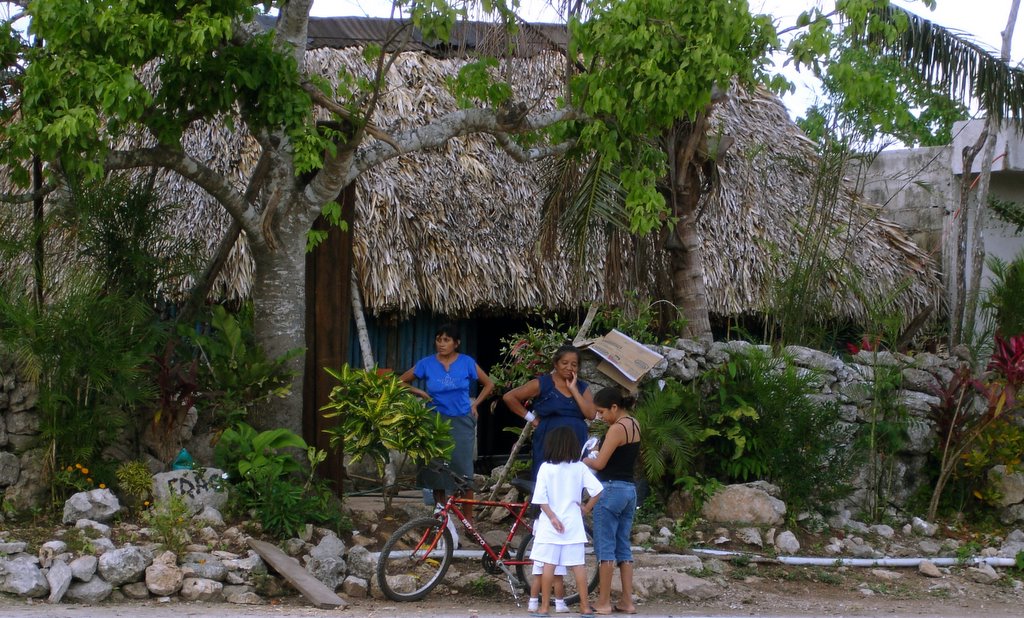 parked outside. Construction work at Cancun and along the Mayan coast had brought money and a long commute to many of the village's younger workers whilst alltournatives seems to provide employment to many of the others. So long as the tourist boom continues so will the villages new found wealth - but I know some people are concerned at the disruption these forces have brought to traditional life. One person later told me some villagers used to party and drink once a week - now it's almost a nightly event.
 The two guys from Phoenix called me over to a small fenced off enclosure. Inside was a really odd looking hairy pig like animal. They were amazed I'd never seen a tapir before - apparently they're quite a common North American animal. But even they had never seen a tame one before. Normally tapirs would be pleased to take a chunk out of any limb offered to them - but this one was happy to munch crisps out of its Mexican owner's hands. Apparently they do taste like pork but are closer to the rat family.
 Luckily the lunch provided didn't include roasting this beastie. Instead a selection of traditional Mexican chillis, Mole Chicken and empanadas were offered with a choice of refreshing cordials made from local flowers. Two well fed locals served us from the buffet - though it's rumoured they usually reheat rather than cook the food from scratch in case any lawsuit-happy weak-stomached Americans come down with food poisoning. Whatever the case the food was excellent.
Heaving our stuffed stomaches back onto the van we then headed onto Coba - once a major centre and home to around 50,000 Mayans. It's far older than Chichen Itza and for more me was a far more satisfying experience.
There was hardly anyone else around as our guide told us only limited excavations had taken place and archaelogists had still to probe into the pyramids to see what they contained. As we stumbled over the rocky path he explained paved roads once connected the site with other Mayan cities - some of the avenues running over 100km. A ball court (far smaller than Chichen Itza's) and a 9-tiered castle have been uncovered but it's believed 95% of the site still lies undercover.
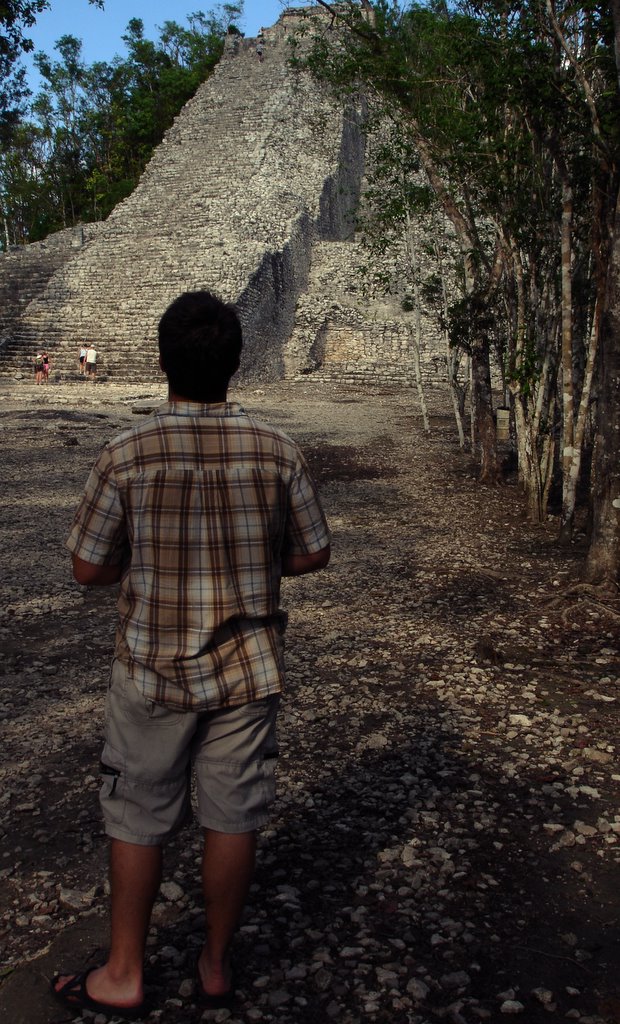 Walking only gets you so far at Coba - the site is far to widely sprawled out to see by foot. So you're given the option of hiring a bicycle or being rikshawed around. The honeymooners took the latter the option while I set off with Dave Henderson and son (the guys from Phoenix) on two wheels to explore. Zipping past each ruin ensured we got the potted highlights and enough time to scale Nohuch Mul - at 138 feet the highest pyramid in the Yucutan.
Unlike at Chichen Itza there's been very little, if any, restoration work, so the climb felt a more authentic and precarious experience. But the view from the top was worth it.
Below stretched miles of jungle with another pyramid encircled by the forest and in the distance floodwater swollen lake gimmered in the sun.
 Looking up the small structure built on the stone mountain's summit Dave spotted a small recess containing carvings that still had hints of once bright paint on them - protected from the rain they offered a hint of how colourful the structure must have been all those centuries ago.
The three of us then raced back to drop off our bikes and get to the van before the others leaving us 15mins to quench ice cold beers from the carpark bar. After all the exercise and humidity they never tasted better.
Then it was time to drive back. Or in our case snooze as our guide stayed alert behind the wheel. I went deep under until we pulled in for the last stop of the day at alltournative's tequila joint. Two shots of one of the best brand's I'd tasted sent a warm feeling under my chest and another grin to my lips.
 On the final 45min stretch back to Playa the Carolina dad told us all it was the first time his family had ever left the States. Previously they'd been on survival training courses and over the remaining miles he gave us a crash course into how to track someone across a forest floor, how to build your own sleeping bag out of dead plants and survive freezing temperatures, how to read someone's state of mind by the footprints they've left and why tracking someone in the dark or across a linoleum floor is easier than it sounds. Fascinating and just a wee bit scary at the same time.
The Hendersons and I were the last to disembark which seemed like a good excuse to round off the remaining daylight with frozen magaritas at one of 5th Avenue's bars. Happy hour meant two for the price of one. My blood alcohol level must have been peaking but I had a huge feeling of contentment rather than tipsiness.
It was the best day's tour - the perfect mix of a fun group, an excellent guide and high adrenaline activities. If you're tempted there's more details and other cheaper tours available at the following link:
But no time to collapse. A quick shower and shave later I picked up Anne-Lie from her cabin at a very dodgy looking small hotel complex and we set off together for my final Mexican Noche. At an even dodgier looking nearby restaurant we asked a waiter where the best place to eat was provoking the predictable response. But once we made it clear we weren't going to stay he pointed us in the direction of Alux.
 I'd already seen the place advertised on flyers at the hostel. It's a huge natural underground cave complex that's been stylishly lit and turned into a bar-eaterie. Walking from 5th Avenue up Juarez Avenue it's a 20 minute walk that took us through the 'real' Playa del Carmen where the locals live and play. Unlike the upmarket tourists patch here we passed half built pavements, huge holes in the road exposing pipes and workmen's tools, shops offering pirated dvds and cheap mobile phones and a mammoth concrete building leaking the sounds of a disco to which no gringo was invited. Obviously most people take a taxi to get there but we both relished the chance to see the resort's other side.
Alux may have been out of town but the prices made clear few locals would ever afford it. The menu wasn't exceptional so we decided to have a couple of cocktails and enjoy the atmosphere before heading back to town later.
No sooner than our order been served the lights dimmed and we heard the sound of live drums from the next door dining room. We poked our heads round to see a group of scantily clad performers garbed in traditional costume acting out an ancient ritual. Our waiter asked if we would like to watch and showed us to the best table in the place - despite the fact we'd made it clear we weren't going to eat.
 The half hour show that followed was another tour highlight and a glimpse into the past. This was no Disneyfied spectacle. The actors took their roles very seriously as the re-enacted a hunt, worship of the old gods and finally the sacrifice of a young virgin. As the lights flickered against the stone walls it was easy to be taken in as the priest plunged his dagger into the girl's chest and then seemed to lift her heart up to the skies as her body fell limp and still. A powerful spinetingling experience for the two of us - but I'm not sure what the diners thought as they munched their way through their steaks. Their romantic meals transformed into a bloody ballet.
 The end of the show was our cue to catch a cab back to town where we had some excellent seafood and ended the night with a couple more frozen magaritas at one of the beach bars. As much as I'd like to say I spent the whole night partying by about 1am I was completely shot. My eyes were sagging and my brain was preparing to shut down. We arranged to meet the next day and I headed back for some of the trips most profound slumber yet.
Nevertheless I awoke less than five hours later bright and if not fully alert at least half way there. Last morning and time was now very precious.
 I lay rocking in my balcony's hammock and watched the sun rise up, blood red, as it began to warm up the sky. Then time to fulfil the last fragments. Fresh fruit in yoghurt for breakfast with Anne-Lie. Then a quick bit of shopping - I got a piece of Oaxacan art I'd spotted days earlier convincing the sales clerk to knock off a healthy percentage by paying in cash. Then a brief luckless search for a strap to prevent my bag springing open again. Hmmm - maybe shouldn't have left that to the last minute but it turned out the airport had a plastic luggage wrap service so it ultimately didn't matter
But before that there was time for a final half hour on the beach. I'd carried around a frisbee for the whole holiday and here at last was the chance to put it to use. Nearly decapitating a couple of passers-by we ran ourselves silly in the sun before finally it was time to say goodbye. Bye to Anne-Lie, bye to Playa, the Yucatan and Mexico itself.
A bus ride and flights lay before me but as I hauled my heavy bag from the hostel to the ADO station I realised it was here that my Mexican Viaje was truly coming to an end. It's probably one of the most intense periods of my life - I don't think I've ever packed so much into such a short period of time. Nevertheless after all the choices of where to go, what tours to take and who to speak to I can look back and say I have no regrets. None at all.
Except maybe I wish I'd taken those salsa dancing classes.....